The burr that invented Velcro
Greater burdock / lesser burdock (Arctium lappa / Arctium minus)
Where you might see it
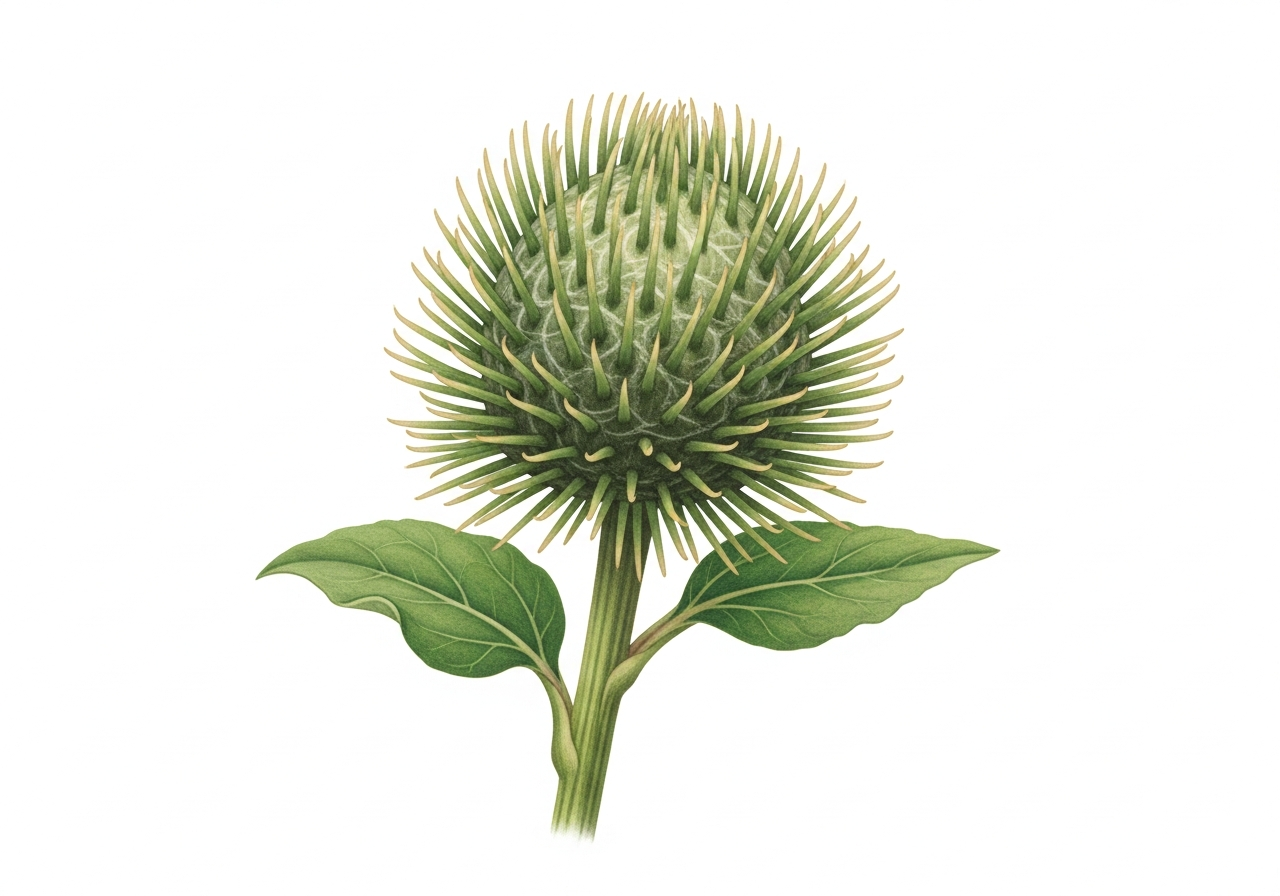
Burdock is a common British plant found along footpaths, hedgerows, and the edges of woods — especially on disturbed ground. In late summer and autumn, its round, spiky seed heads ripen into burrs that catch on clothing and animal fur. If you've ever come home from a walk with a dog covered in prickly brown balls, you've already met burdock. The burrs are a nuisance — but they're also one of the most important ideas in the history of invention.
Nature's problem
Burdock is a plant, and plants can't walk. So how does burdock spread its seeds away from the parent plant to find new places to grow?
Nature's solution
Each burdock burr is covered in hundreds of tiny hooks, each one curving over at the tip like a very small shepherd's crook. When an animal brushes past, these hooks catch on loops of fur or fabric and the burr hitches a ride — sometimes for miles — before eventually falling off. The plant uses passing animals as its transport system, and the hooks are its ticket.
What people made
In 1941, a Swiss engineer named George de Mestral came home from a walk in the mountains to find his dog covered in burdock burrs. Instead of just pulling them off and grumbling, he looked at one under a microscope. He saw the tiny hooks very clearly, and he wondered: could you make a fastener that worked the same way? It took him ten years, but in the early 1950s he created what we now call Velcro — one side covered in tiny hooks, the other in tiny loops. Press them together and they grip; pull them apart and they release cleanly. Today Velcro is used on shoes, bags, spacecraft, and surgical equipment all over the world.
Try this
Find a burdock plant on an autumn walk and collect a few burrs (with gloves if you like!). Under a magnifying glass, look closely at the hook tips. Can you see how they curve over? Now press one onto a woolly jumper and pull it off gently. You've just re-enacted the moment that gave George de Mestral his idea.
Curriculum links
Plants — seed dispersal and plant structures
Burdock burrs attach to animal fur to hitch a ride and disperse seeds away from the parent plant — the hook structure that inspired Velcro is, first and foremost, a seed-dispersal mechanism, making this the most accessible entry point for KS2 plant biology.
Explore this on the site: Year 3: Plants
Evolution and inheritance — how natural selection shapes plant structures
The burdock burr's hooked structure was not designed to inspire fasteners — it evolved to grip fur as a seed-dispersal strategy — a vivid illustration of how natural selection produces structure and function that humans later recognise as useful.
Explore this on the site: Year 6: Evolution and inheritance
Design — understanding how products are invented and improved
Velcro is the canonical biomimicry story: George de Mestral noticed burrs on his dog's fur, looked closely, and invented one of the world's most widely used fasteners — a story all primary pupils can follow and that shows design as an act of careful observation.
Writing — narrative and biographical writing, stories of invention
The Velcro origin story is an ideal subject for biographical or narrative writing — a short walk in the Alps, a curious observation, ten years of work — giving younger KS2 pupils a real, true story of invention to retell or dramatise.