The spider's thread stronger than steel
Orb-weaver spiders, principally golden silk orb-weaver (Nephila spp.) and garden cross spider (Araneus diadematus)
Where you might see it
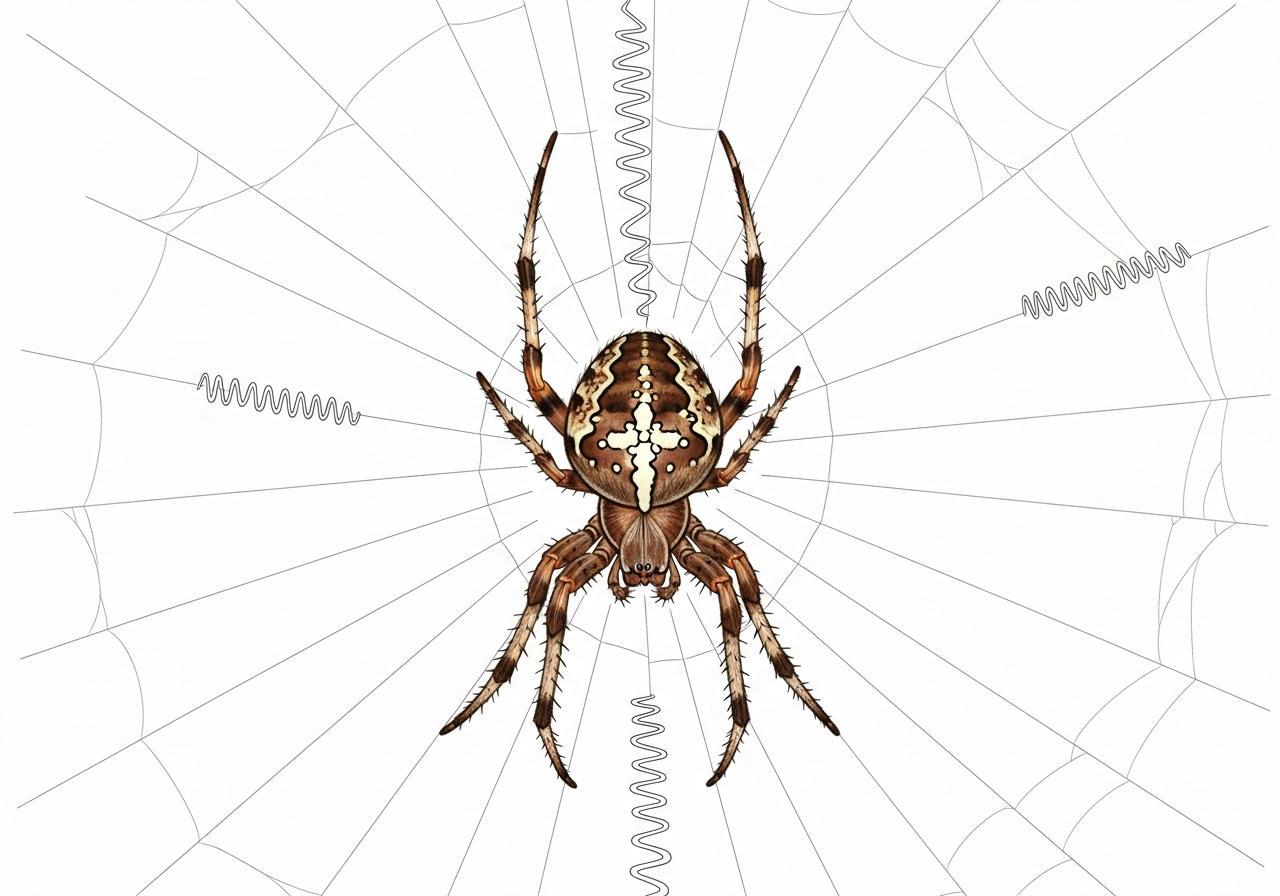
The garden cross spider is one of Britain's most familiar spiders — large, with a distinctive white cross on its abdomen, spinning beautiful orb webs in hedges and garden shrubs every autumn. On a dewy morning, look for the spiral of sticky threads glistening with droplets. The radial threads running out from the centre — the 'spokes' — are made of a different silk: dry, incredibly strong, and not sticky at all. Those threads are some of the toughest natural fibres on Earth.
Nature's problem
A spider needs to spin a web that will catch flying insects without breaking. But the web has to be light enough for the spider to carry, flexible enough not to shatter when an insect hits it, and strong enough to hold a struggling creature until the spider can reach it.
Nature's solution
The radial threads of an orb web are made of a silk that is stronger than steel wire of the same thickness and can stretch by a third of its length before snapping. That combination — very strong AND very stretchy — is extraordinarily rare in nature or in manufacturing. The spider produces two different silk proteins and spins them together into a single thread inside its body, pulling the thread through a tiny tube that arranges the proteins into a structure that gives both stiffness and springiness at once. No factory has yet managed to copy this spinning process precisely.
What people made
Scientists have decoded the recipe for spider silk proteins and can now grow them using bacteria and yeast in fermentation tanks — a bit like brewing beer, but making silk instead of alcohol. Companies in Germany, Japan, and the United States are turning this laboratory silk into real fibres used in biodegradable trainers, luxury watch straps, car interiors, and experimental medical sutures that dissolve safely inside the body once a wound has healed. Because the silk breaks down naturally, products made from it can be composted rather than adding to landfill. Spider silk is still expensive to make at scale, but scientists are getting closer to matching what the spider does every day for free.
Try this
Find a garden cross spider's web on a dewy autumn morning. Touch the radial 'spoke' threads with a twig — notice they are dry and very springy, not sticky. Now touch the spiral threads gently — they are sticky and stretch much more. The spider uses different silks for different jobs. Can you work out which threads are the load-bearing ones and which ones catch the prey?
Curriculum links
Properties and changes of materials — comparing the properties of natural and synthetic materials
Spider silk is stronger than steel yet lighter than nylon, and biodegrades safely — a powerful example for comparing properties of natural and manufactured materials and exploring what makes a material suitable for a given purpose.
Animals including humans — how animals produce useful structures for survival
The orb-weaver spider spins a web with radial load-bearing threads and spiral sticky threads, each made of different silk with different properties — an accessible, garden-familiar example of an animal producing specialised materials to survive and catch food.
Explore this on the site: Year 4: Animals, including humans
Evolution and inheritance — adaptations and the diversity of life
Different spider species have evolved different silk types for different purposes — dragline, sticky, egg-sac, swathing — illustrating how natural selection drives material specialisation and how diversity within one group of organisms can be enormously rich.
Explore this on the site: Year 6: Evolution and inheritance
Technical knowledge — selecting materials for performance, sustainability, and function
Synthetic spider-silk fibres are being used in biodegradable trainers and medical sutures, showing pupils that copying how nature makes materials — rather than just what they look like — can lead to products that are both high-performing and environmentally responsible.