The body's shortcut that acts before you think
Human (Homo sapiens) — and every animal with a backbone
Where you might see it
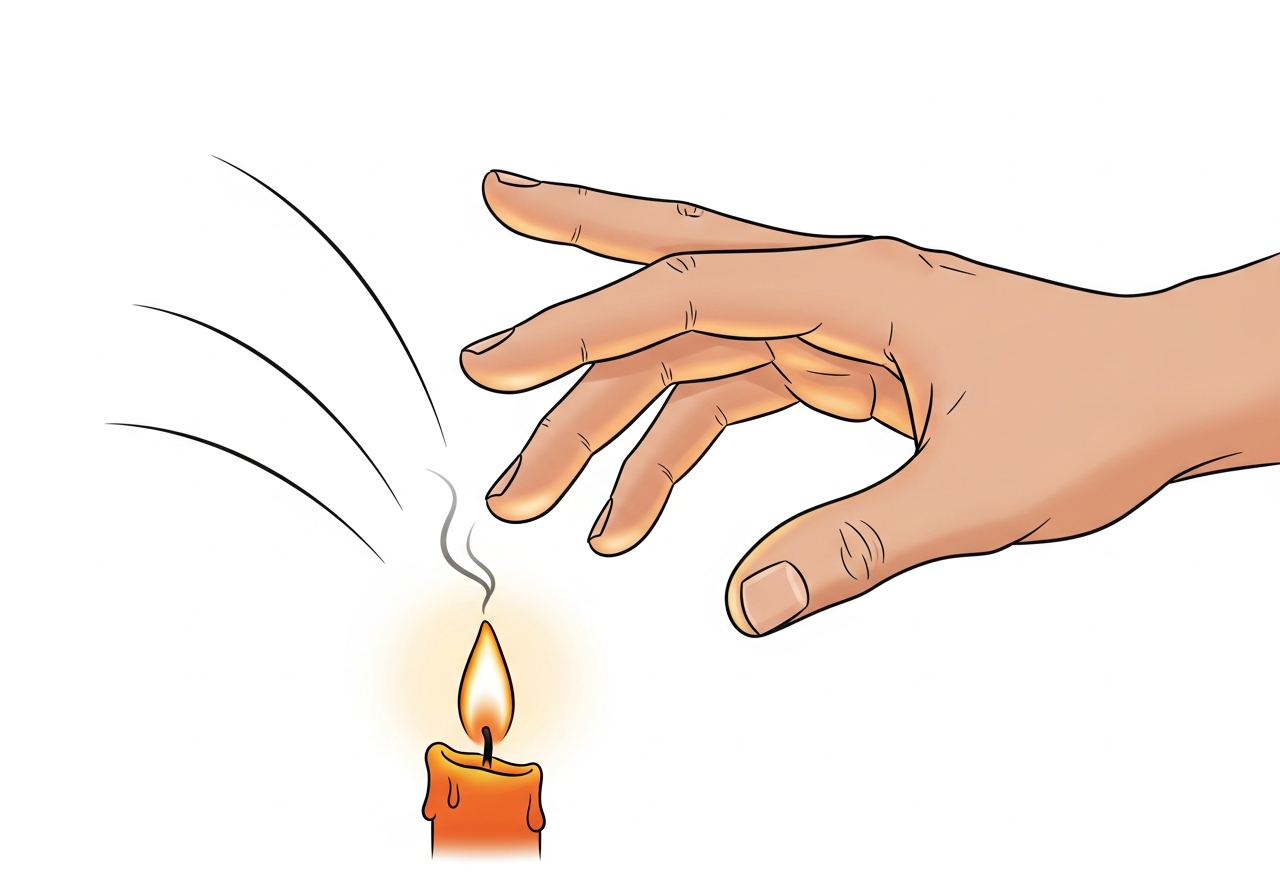
In your own body, every day. The hand you snatch back from a hot pan before it even hurts. The blink when something flies towards your eye. The way your leg kicks when a doctor taps just below your kneecap — a kick you cannot stop even if you try.
Nature's problem
Some dangers happen far too fast to think about. A message takes time to travel all the way up to the brain, wait for it to decide 'what shall I do?', and travel all the way back. In that time, you could already be burned.
Nature's solution
For the most urgent jobs, the body takes a shortcut called a reflex. The 'danger!' signal races only as far as the spinal cord — the thick bundle of nerves running up your back — which fires the order 'pull away!' straight back to the muscle, skipping the brain altogether. It saves a fraction of a second, and that fraction is enough to save you from a burn. You feel the pain a moment later, once the slower message reaches your brain.
What people made
Engineers build this very same shortcut into machines — though they worked it out for themselves, not by studying our nerves. A circuit breaker snaps the electricity off the instant too much flows, without waiting for a person to decide. A car's airbag fires by itself in a crash, and many cars can brake on their own if something darts in front. All of them skip the slow 'thinking' part and act at once, exactly as a reflex does. For the fastest, most important jobs, 'act now, think later' is simply the best design — whether you are a body or a machine.
Try this
Ask someone to hold a ruler straight up and let go without warning, while you hold your finger and thumb ready at the bottom. Try to pinch it as it falls. The distance it drops before you catch it is your reaction time — the time a signal needs to go up to your brain and back. A true reflex would be even quicker, because it never bothers the brain at all.
Curriculum links
Electricity — the body's electrical signals and automatic switches
Links the idea of electrical signals and switches to the body: a reflex is a tiny circuit that switches on a muscle automatically, just like a switch closing in a circuit.
Explore this on the site: Year 4: Electricity
Electrical systems and control — automatic responses
A real-world way in to control and sensing: machines, like bodies, can be built to respond to danger automatically without a person deciding each time.