The owl that flies in silence
Barn owl (Tyto alba) and related species
Where you might see it
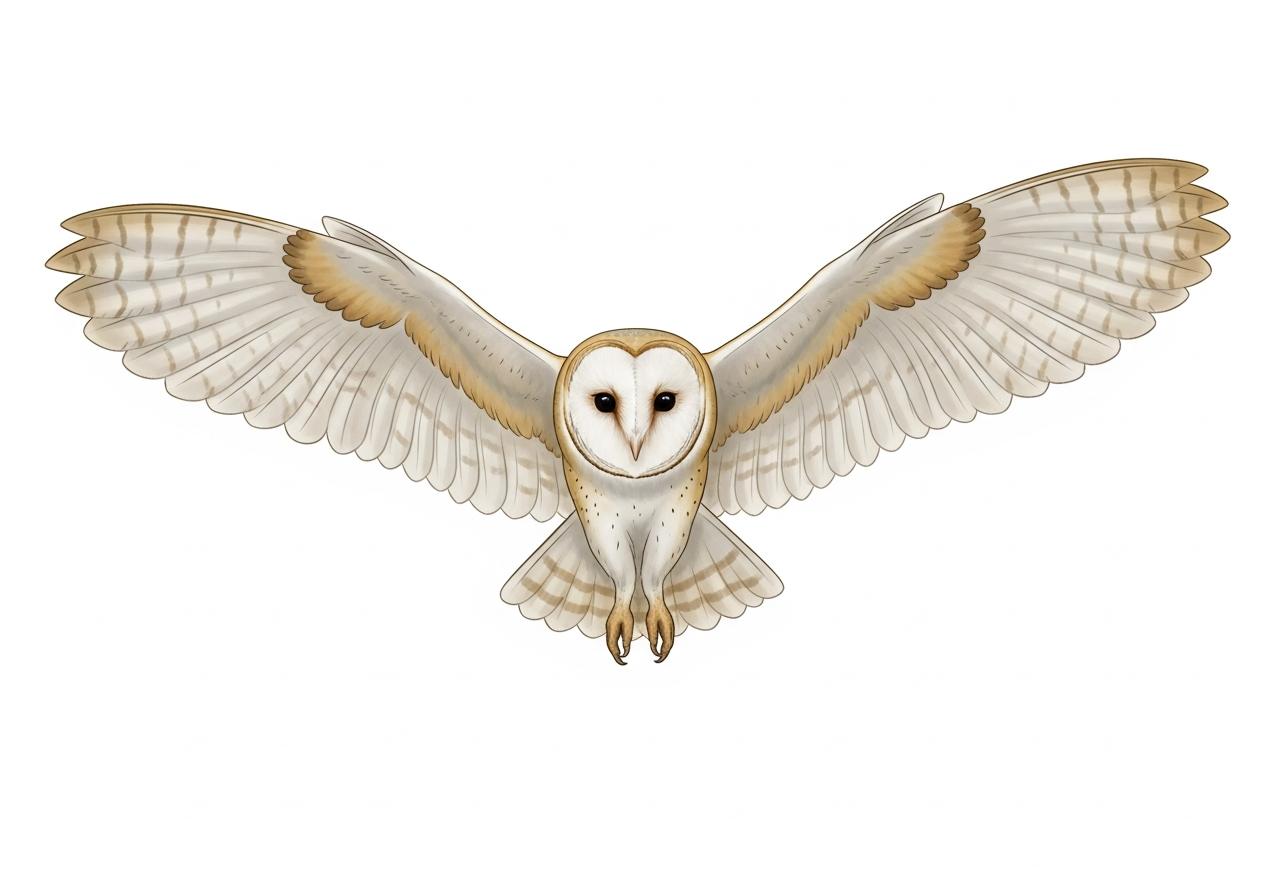
Barn owls live all across Britain and can be seen quartering over fields and meadows at dusk, their white heart-shaped faces ghostly in the fading light. Unlike most birds, a flying barn owl makes almost no sound at all — you can sometimes watch one pass just a few metres away without hearing a single wingbeat. That silence is not an accident.
Nature's problem
Owls hunt small mammals — mice and voles — by sound. They can hear a mouse rustling in the grass from thirty metres away. But if the owl's wings made a whooshing noise when it flew, the sound of its own flight would drown out the tiny sounds of its prey below. The owl needs to fly in complete silence.
Nature's solution
Barn owl feathers have three clever features working together. The leading edge of each large feather is fringed with tiny comb-like serrations, like the teeth of a very fine comb. These break up the rush of air into smaller, quieter swirls. The upper surface of the feathers is covered in soft, velvety hairs that muffle any remaining sound. And the trailing edge of each feather is ragged and wispy, smoothing the turbulent wake behind the wing. Together, these three things cut the sound of flight to almost nothing.
What people made
Engineers at Cambridge University studied barn owl feathers and showed that the comb-like serrations alone could reduce the noise of a blade moving through the air by up to 10 decibels — that's about the same difference as a quiet conversation compared to a normal one. Wind turbine companies have started fitting serrated, comb-like edges to their turbine blades, cutting the noise they make by up to half. This matters because noise is one of the main reasons people object to wind farms being built near their homes — quieter turbines can be built in more places, generating more clean electricity.
Try this
Listen very carefully the next time a bird flies past you quickly. Can you hear the wings? Now think: if you were hunting by listening for tiny sounds, what would happen to your hearing if your own wings were noisy? How would you need to evolve?
Curriculum links
Sound — how sound travels and what affects its loudness
Barn owl feathers suppress flight noise through their physical structure — a remarkable real-world demonstration that sound can be reduced by changing a surface's texture, directly linking to Year 4 study of sound and vibration.
Explore this on the site: Year 4: Sound
Evolution and inheritance — adaptation and predator-prey relationships
Silent flight is a hunting adaptation — owls that make less noise catch more prey — making this a clear example of how natural selection drives extraordinary specialisation in an animal pupils are likely to have heard or seen locally.
Explore this on the site: Year 6: Evolution and inheritance
Design — evaluate and improve a product by studying its natural equivalent
Serrated turbine-blade edges copied from owl feathers halve the noise of wind farms, giving pupils a concrete case of a real-world DT problem — public opposition to noisy turbines — solved by observing a British bird.
Human and physical geography — renewable energy and land use
Quieter turbine blades made possible by copying the barn owl can be sited closer to villages, directly connecting pupils' geographical understanding of energy supply and land use decisions to a nature-inspired design solution.
Explore this on the site: Key Stage 2: Geography