The beetle that drinks the fog
Namib desert beetle (Stenocara gracilipes) and several desert plants
Where you might see it
The Namib is one of the world's oldest and driest deserts, running along the Atlantic coast of southern Africa. Almost no rain falls there — yet every morning, a cold sea fog rolls in from the ocean. The beetle that lives there has found a way to drink that fog. In Britain, you might notice something similar on a cold morning: tiny water droplets forming on a spider's web or on a car windscreen. That's the same process — water from the air condensing onto a cold surface.
Nature's problem
There is almost no rain in the Namib Desert. But there is fog — a thin, misty cloud that drifts in from the cold Atlantic Ocean most mornings. How can a beetle drink something as wispy as fog?
Nature's solution
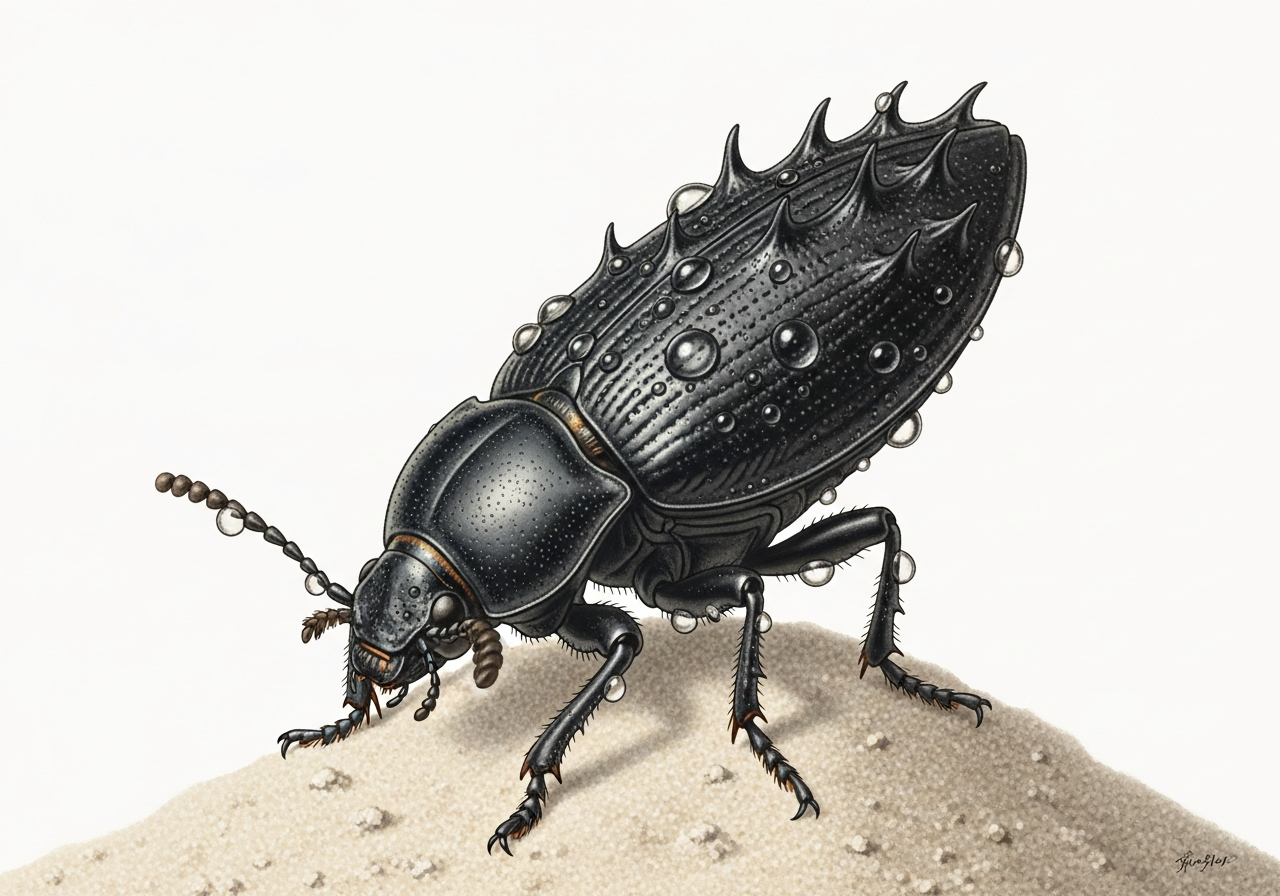
The beetle stands on top of a sand dune with its back tilted into the wind. Its back is covered in a pattern of tiny bumps and smooth channels. The bumps attract water — fog droplets land on them and stick. The channels are waxy and water-repelling, so once a droplet grows big enough, it rolls quickly along the channel all the way down to the beetle's mouth. It's like the beetle has its own tiny water-collecting machine built into its skin.
What people made
Engineers inspired by the beetle — and by desert plants like cactus spines and mosses that use similar tricks — have built large mesh nets that collect fog in the same way. In Morocco, a system of 31 nets the size of tennis courts collects around 37,000 litres of clean drinking water on foggy days. This water is piped to 1,300 people in 16 remote Berber villages in the mountains, where there is no other reliable water source. Similar nets have been installed in Chile and other dry coastal countries. The nano-scale patterns from the beetle are still being refined — future nets may collect even more water by copying the beetle's surface more precisely.
Try this
On a cold morning, look at a spider's web outside. Where do the droplets form — on every thread, or on particular parts of the web? Why do you think some parts collect more water than others?
Curriculum links
States of matter — condensation and the water cycle
The Namib beetle collects water by condensing fog droplets on its back — a vivid, organism-scale demonstration of condensation that makes the abstract concept concrete for Year 4 pupils.
Explore this on the site: Year 4: States of matter
Locational knowledge and human and physical geography — desert climate zones, water scarcity, and the water cycle
The beetle lives in the Namib desert, one of the world's driest places, yet harvests water from coastal fog — a powerful geographical story linking desert climate zones, water scarcity, and the physical processes of the water cycle.
Explore this on the site: Key Stage 2: Geography
Properties and changes of materials — how surface properties can be used to collect water
The beetle's alternating water-attracting and water-repelling surfaces work together to collect and channel water — showing pupils that surface properties at a tiny scale can solve a large practical problem.
Human geography — water supply, sustainable development, and global challenges
Beetle-inspired fog-harvesting nets are being used to provide clean water in arid regions of Africa and South America without any power source, connecting geographical knowledge of water scarcity to real humanitarian innovation.
Explore this on the site: Key Stage 2: Geography