The mussel's miracle glue
Common mussel (Mytilus edulis) and related species
Where you might see it
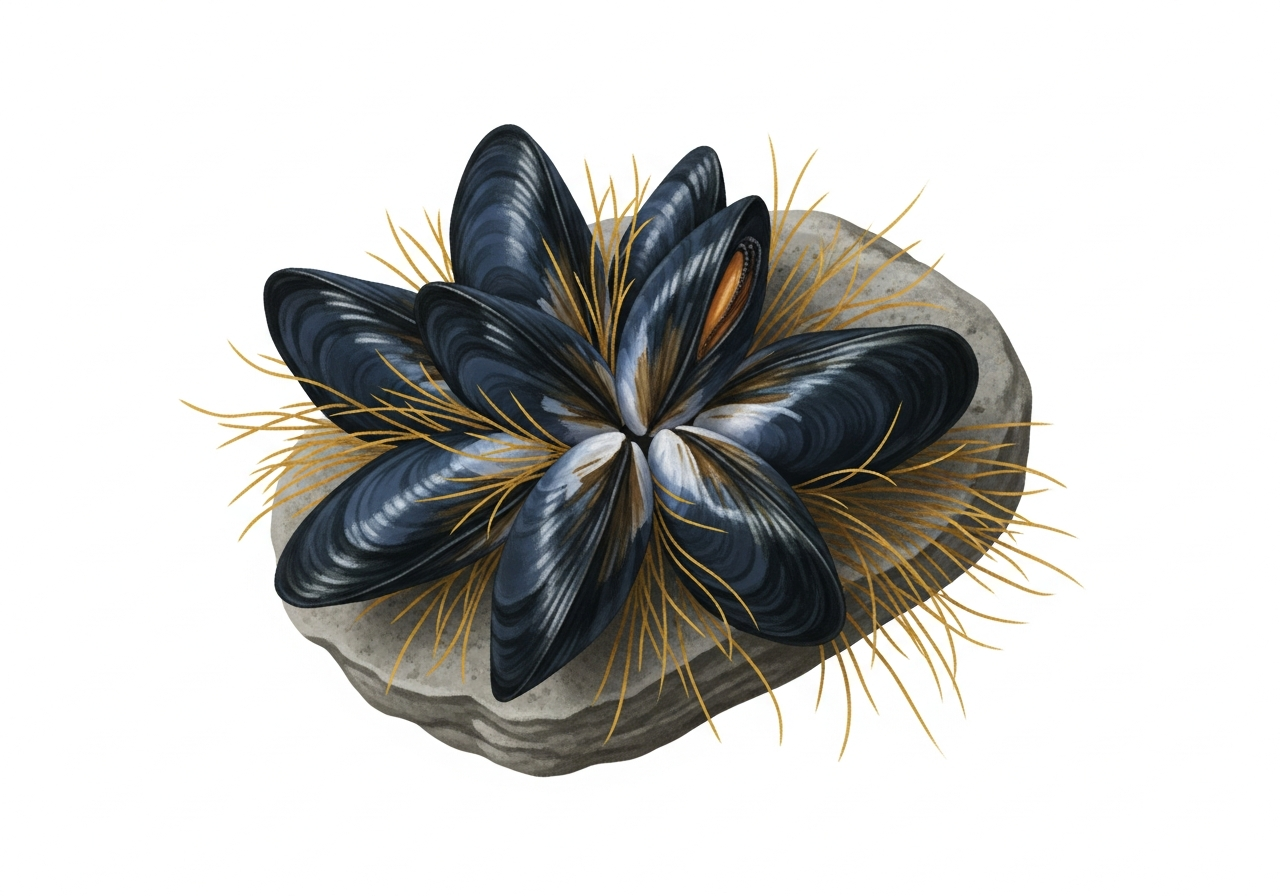
Common mussels are found all around the British coastline — clustered on rocks, harbour walls, and piers wherever the tide comes and goes. Next time you're at the seaside, look for dark blue-black shells in bunches on exposed rocks. Tug gently at one: you'll feel the tough, hair-like threads anchoring it firmly to the rock, even as waves crash over it. Those threads are one of the strongest natural glues in the world — and they work underwater.
Nature's problem
A mussel lives in one of the toughest places imaginable: on a rock being battered by powerful waves, all day and all night, in cold salty seawater. If it lets go, it will be dashed to pieces. But ordinary glue dissolves in water — it can't do the job.
Nature's solution
The mussel makes its own special glue from proteins produced in its foot. It presses its foot against the rock and secretes these proteins, which seep into the tiniest gaps in the rock surface and grip tight. The special ingredient in the proteins first clears away the thin film of water on the rock — creating a brief dry patch — and then bonds powerfully to the rock itself. No manufactured glue has managed to do this as well as a mussel.
What people made
Scientists have studied these mussel proteins carefully and started making versions of them in the laboratory. One mussel-inspired surgical glue can seal a bleeding wound in under a minute — in wet, bloody tissue where ordinary stitches and staples can be difficult to use. Because it's made from proteins, the body can safely break it down once the wound has healed. Research is still ongoing, but mussel-inspired materials could one day make surgery safer, quicker, and gentler.
Try this
Try to get two smooth tiles or pieces of plastic to stick together using ordinary PVA glue — once dry, does it hold? Now get them wet and try again. What happens? Now you understand exactly why the mussel's wet-grip glue is so extraordinary.
Curriculum links
Properties and changes of materials — comparing how materials behave under different conditions
Mussels glue themselves to wet rocks where synthetic adhesives fail — a clear, testable comparison that introduces the idea that some natural materials have properties our manufactured equivalents have not yet matched.
Evolution and inheritance — adaptation to challenging habitats
The mussel's byssus threads and wet adhesive are evolutionary adaptations to life in the wave-battered intertidal zone — an excellent example of a tough environment driving an extraordinary biological solution.
Explore this on the site: Year 6: Evolution and inheritance
Living things and their habitats — how animals are suited to their habitat
Common mussels live in one of the most physically demanding UK habitats — pounded by waves on rocky shores — and their attachment mechanism explains how they survive where most animals could not.
Explore this on the site: Year 4: Living things and their habitats
Technical knowledge — understanding how new materials inspired by nature solve design problems
Mussel-inspired surgical glues that seal wounds in saltwater conditions show pupils a direct line from observing how a common UK shore animal clings to rock, to a medical invention that saves lives.