The shrimp with the world's most powerful punch
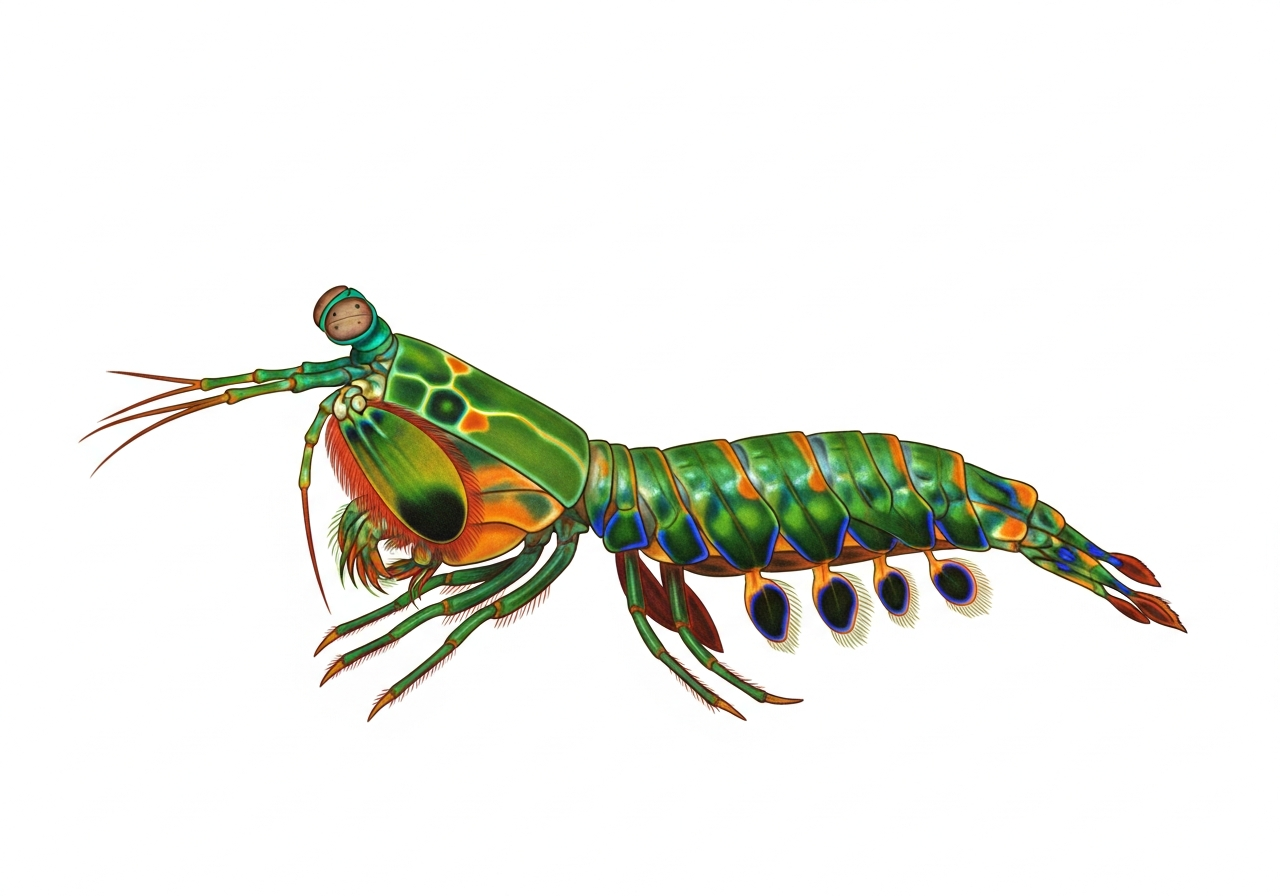
Peacock mantis shrimp (Odontodactylus scyllarus)
Where you might see it
Mantis shrimps live in warm tropical oceans — they're not found in UK waters. But they are some of the most extraordinary-looking animals on Earth: their bodies are covered in vivid blues, greens, and oranges, a bit like a living jewel. If you ever visit an aquarium you might see one — look out for tanks with special thick glass, because a mantis shrimp can smash a normal aquarium pane with a single strike.
Nature's problem
The peacock mantis shrimp hunts crabs and snails by smashing their shells open. To do that it needs to deliver an incredibly powerful punch — far faster and harder than anything a creature its size should be able to manage. But if it punched that hard with an ordinary limb, it would shatter its own club in the process.
Nature's solution
The mantis shrimp's clubbing limb is built like a carefully engineered shield. Inside, it has layers of mineralised fibres arranged in a spiral — like a very tightly wound spring or the layers in a croissant, but twisted round and round. When a crack tries to form from an impact, it has to follow the spiral, twisting and turning instead of going straight through. By the time it's finished twisting, the energy of the impact has been used up. The club can strike thousands of times and never crack.
What people made
Materials scientists at a university in California studied this spiral-layered structure very carefully. They then made carbon fibre panels — the material used in racing cars, aircraft, and cycle helmets — with layers arranged in the same spiral pattern instead of the usual criss-cross. The spiral-layered panels were about 20% tougher than normal panels using exactly the same materials. The same amount of carbon fibre, arranged differently, becomes harder to smash. That could mean lighter, safer helmets and aircraft panels.
Try this
Take a sheet of paper and try to tear it in a straight line. Now fold a piece of paper into many diagonal layers and try to tear through all of them at once. Which is harder? The mantis shrimp's spiral layers work on the same principle — every layer the crack meets is at a different angle, and that makes it very hard for the crack to keep going.
Curriculum links
Forces — impact forces and how materials absorb them
The mantis shrimp delivers a punch faster than a bullet yet its club never cracks — pupils can explore how the spiral internal structure of the club distributes and absorbs impact forces, connecting directly to forces topics.
Properties and changes of materials — how the structure of a material affects its strength and toughness
The mantis shrimp's club is made of the same materials as other animals' shells yet is far tougher, because its layers are arranged in a spiral — showing that the same substance, arranged differently, can behave in a completely different way.
Animals including humans — animal feeding and predator adaptations
The peacock mantis shrimp smashes crab shells with its club to access food — an extraordinary predator adaptation that brings animal feeding strategies vividly to life and prompts questions about why no other animal has evolved a similar weapon.
Explore this on the site: Year 4: Animals, including humans
Technical knowledge — selecting and evaluating materials based on their properties
Aerospace engineers have copied the mantis shrimp's layered structure to make lighter, tougher helmets and aircraft panels, showing pupils how a deep understanding of a material's internal arrangement leads to better-designed products.