The whale that improved the wind turbine
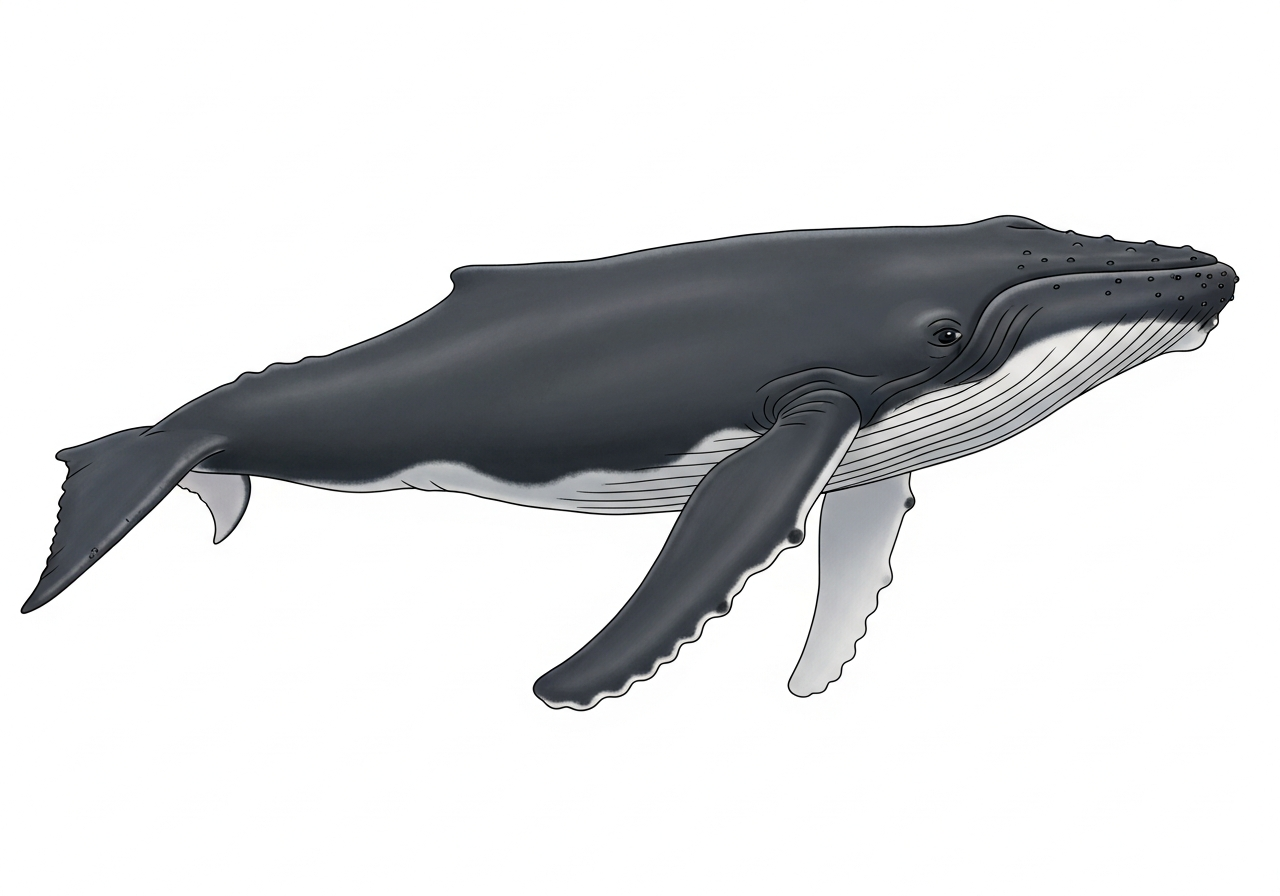
Humpback whale (Megaptera novaeangliae)
Where you might see it
Humpback whales live in all the world's oceans and migrate past the coasts of Britain — whale-watching trips from Cornwall, Wales, and Scotland sometimes spot them. They're the size of a bus and famous for their spectacular leaping and singing. Despite being enormous, they can spin and twist in tight circles to herd fish — and their fins are why.
Nature's problem
A humpback whale is huge and heavy, yet it needs to make sharp, quick turns to herd fish into a ball before rushing through them with its mouth open. How can something that massive turn so neatly?
Nature's solution
The humpback's front fins have a row of bumps along the leading edge, a bit like knuckles. These bumps break up the water flowing over the fin in a way that stops it from suddenly 'stalling' and losing grip. Instead of sliding sideways when it tries to turn sharply, the fin holds on — letting the whale carve tight circles that would be impossible with a smooth fin.
What people made
Engineers in Canada noticed these bumps and tried adding the same knobbly pattern to wind turbine blades. In wind-tunnel tests, the bumpy blades produced more power and made less noise than smooth blades. Some large ceiling fans now use the same idea and use about one fifth less electricity than ordinary fans. Quieter, more efficient wind turbines could help us generate more clean energy.
Try this
Hold a flat piece of card in a breeze and angle it so the air flows over it. At what point does it suddenly lose lift and flap? Now try gently crimping one edge into small waves. Does the card hold its angle better? You're recreating the whale's fin experiment.
Curriculum links
Forces — air resistance and how shape affects movement through fluids
The tubercles on a humpback whale's fin reduce drag and improve lift, directly paralleling the Year 5 topic of how shape affects movement through water and air, with a memorable mega-fauna example.
Living things and their habitats — adaptation and feeding behaviour
The tubercles allow humpbacks to make tight turns when corralling fish during bubble-net feeding — a vivid link between body structure, hunting strategy, and survival that brings adaptation to life.
Explore this on the site: Year 4: Living things and their habitats, Year 6: Living things and their habitats
Design — evaluate existing products and learn from natural systems
Wind turbine blades shaped after humpback fins generate more electricity with less noise — pupils can see how a design improvement borrowed from a whale solves a real engineering problem.
Human and physical geography — renewable energy and sustainable development
The tubercle-inspired wind turbine is a clear real-world link between geographical understanding of the need for renewable energy and the role that nature-inspired design plays in making that energy more efficient.
Explore this on the site: Key Stage 2: Geography