The gecko that walks up walls
Tokay gecko (Gekko gecko)
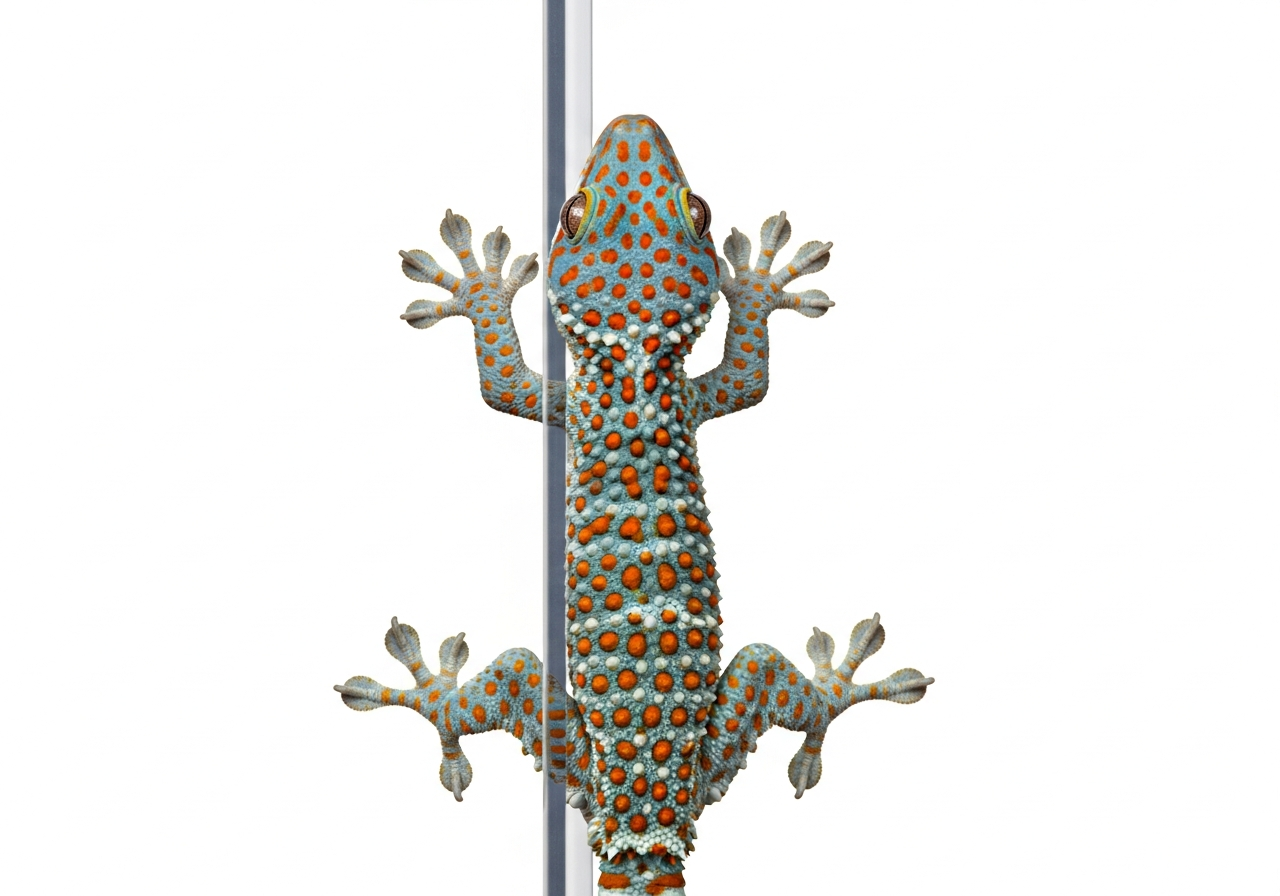
Where you might see it
Tokay geckos live in tropical forests and warm buildings across South-East Asia — not in the UK. But if you've ever seen a spider walk up a wall, or watched a fly land on a window, you've seen a smaller version of the same mystery: how does an animal stick to a smooth surface without glue? Imagine a lizard the size of your hand doing the same thing.
Nature's problem
A gecko needs to chase insects across smooth walls and ceilings. If it slips, it falls. And it can't use sticky glue — it needs to pick up its feet and move them again in an instant.
Nature's solution
Each of the gecko's toes is covered in millions of hair-like bristles, so tiny you'd need a microscope to see them. At the very tip of each bristle are even tinier paddle shapes. There are so many of them that together they create a very gentle invisible pull — like the force that makes two pieces of glass stick together when they're wet. The gecko just peels its toes away to let go, instantly and cleanly, leaving no sticky mess behind.
What people made
Scientists have been trying to copy this trick to make a tape that you can stick, peel off, and reuse thousands of times without any glue — and without leaving any marks. Space agencies are interested in it for robot arms that can grip satellites without damaging them. Surgeons want a version that could close wounds without stitches or staples. It's still being developed, but some gecko-inspired films are already available.
Try this
Press two small pieces of clean glass together gently. Do they seem to stick a little? Now slide them apart. The tiny invisible pull you felt is the same kind of force the gecko uses — just a million times stronger because the gecko has millions of tiny surfaces all working together.
Curriculum links
Animals including humans — how animal body structures are suited to their environment
Gecko toe pads are a striking example of an animal structure perfectly matched to its environment — clinging to vertical surfaces without glue — giving pupils a memorable hook for studying adaptation.
Explore this on the site: Year 4: Animals, including humans
Properties and changes of materials — comparing materials by their properties
The gecko's adhesion works through surface structure rather than sticky chemistry, introducing the idea that how a material is shaped at a tiny scale can change what it can do — a gateway to thinking about material properties beyond simple categories.
Design — applying understanding of computing, science, and mathematics to solve problems
Gecko-inspired adhesives used in robotic grippers and medical dressings show pupils how understanding nature at a microscopic level leads to genuinely new products, linking DT to science investigation.
Evolution and inheritance — adaptation to environment
The gecko's microscopic toe hairs are an evolutionary adaptation allowing survival in habitats inaccessible to competitors — an excellent example of how structures at a scale we cannot see with the naked eye underpin an animal's survival strategy.
Explore this on the site: Year 6: Evolution and inheritance