The boxy fish and the low-drag car
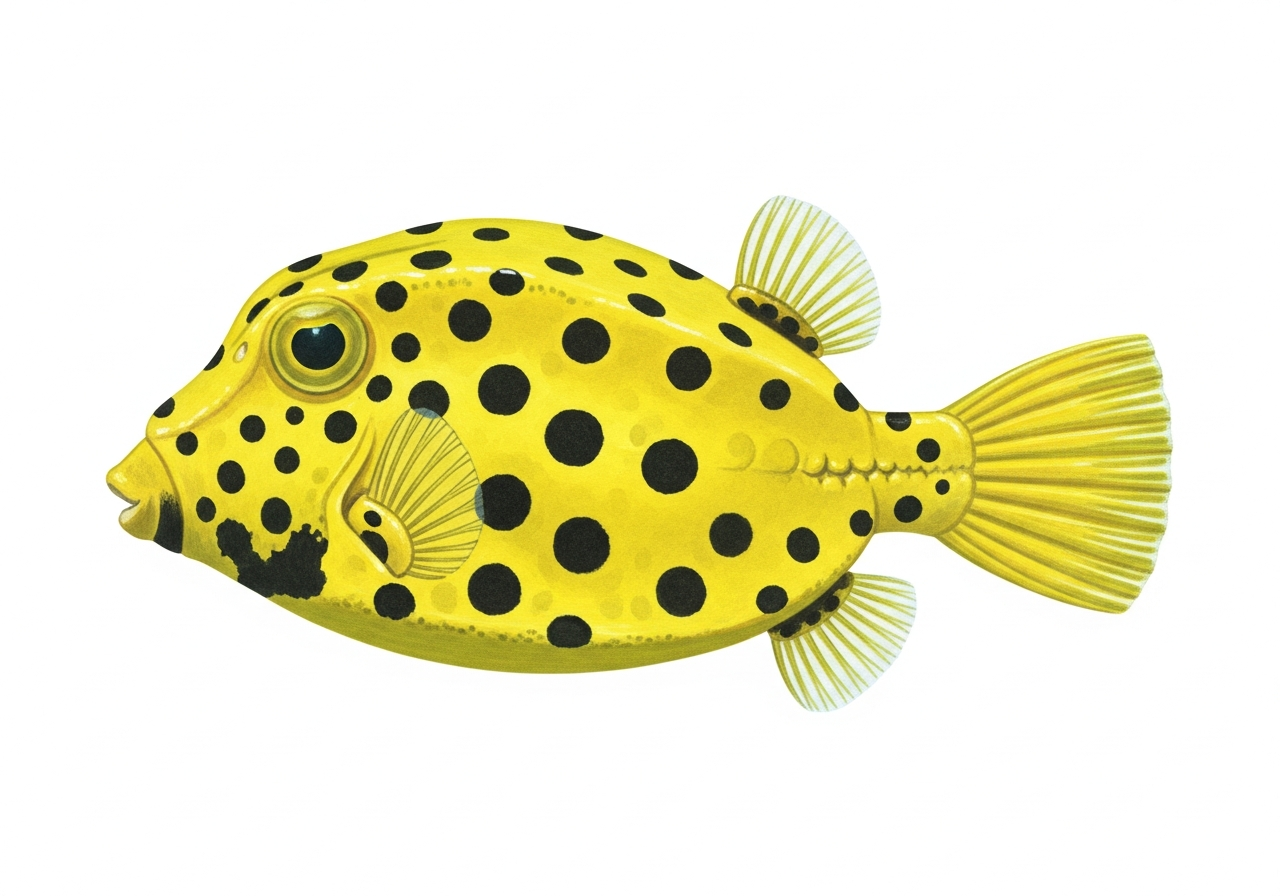
Yellow boxfish (Ostracion cubicus)
Where you might see it
Yellow boxfish live in tropical coral reefs in the Indo-Pacific — the warm, shallow oceans around the Philippines, Indonesia, and Australia. They're not UK animals, but you might see one in a public aquarium. Young ones are bright yellow with black spots and almost perfectly cube-shaped — it looks as though nature made a mistake and forgot to give this fish a streamlined body. But watch it move through the water and you'll see it's surprisingly nimble.
Nature's problem
The boxfish lives in a coral reef, where it needs to twist and turn through tight gaps without bumping into things. Its bony box-shaped shell protects it from predators, but that same shape seems like it should make swimming very difficult.
Nature's solution
The boxfish moves remarkably well despite its shape. Engineers at Mercedes-Benz measured how much resistance the boxfish body created in a wind tunnel and found the number was very low for a shape that boxy. The rounded curves of its carapace — its bony outer shell — seem to guide the water around it smoothly. Scientists are still debating exactly why it works so well: it turns out that rather than being naturally stable like a boat, the boxfish is actually quite wobbly, and uses its fins constantly to keep course. It may be that the real secret is the fins, not the shell — and the full story isn't settled yet. Science often works this way: a first idea turns out to be more complicated than it seemed.
What people made
In 2005, Mercedes-Benz engineers used the outer shape of the boxfish as the starting point for a concept car called the Bionic. Working from the fish's proportions, they designed a car body with a drag coefficient of 0.19 — exceptionally slippery for a full-sized family car at the time. They also used a method inspired by how bones grow to make the car's internal structure lighter and stronger. Some of the ideas from that project were later used in real production cars. The boxfish story also teaches us something important about science: even when a first idea turns out to be incomplete, it can still lead to genuinely useful discoveries.
Try this
Find a small cardboard box and a rounded pebble of about the same size. Hold each one in front of a fan or out of a moving car window (carefully, with an adult!). Which shape creates more resistance? Can you feel a difference? Now think: could a rounded box be more slippery than it looks?
Curriculum links
Forces — drag, streamlining, and resistance
The yellow boxfish looks box-shaped yet moves efficiently through water — a counter-intuitive hook for exploring how the relationship between shape and drag is more complex than it first appears, enriching Year 5 forces work.
Animals including humans — animal movement and body structures in aquatic habitats
The boxfish navigates coral reefs with precise, agile movements despite its rigid bony shell — a striking example of how an animal's body structure relates to its habitat and movement, and how stability can be achieved in unexpected ways.
Explore this on the site: Year 4: Animals, including humans
Design — evaluating designs using evidence and testing
The Mercedes Bionic story also illustrates that biomimicry must be grounded in accurate science — later research showed the boxfish story was more complicated than first thought — modelling for pupils the importance of testing and questioning design claims.
Human and physical geography — transport, fuel efficiency, and sustainability
A car designed around a fish shape that uses significantly less fuel than conventional designs connects DT thinking to geographical concepts of resource use, transport, and the environmental impact of how things are made.
Explore this on the site: Key Stage 2: Geography